
Research Lab

Computational Multi-Omics

COMICS 20202
29685

Lab Members

Lab leader

Independent researcher

Postdoctoral Researchers

PhD students

Research Interests

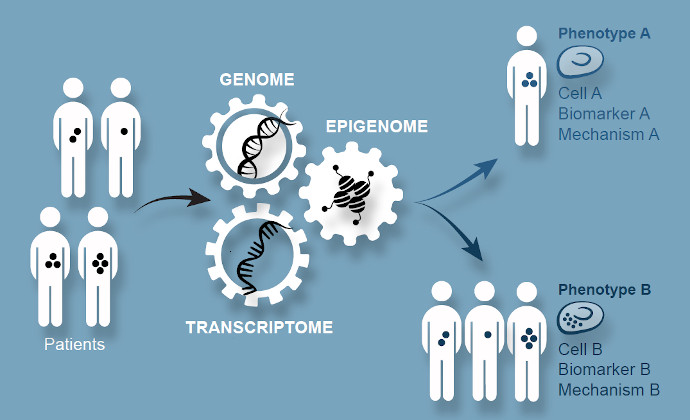
Our mission is to understand the (epi)genome biology and its impact on pathological conditions using computational multi-omics approaches. Such methods rely on the statistical analysis and integration of big data (high-throughput sequencing, microarrays, proteomics, high-throughput screening) and clinical/phenotypic data.


The regulation of (epi)genome and transcriptome networks is a crucial component of a healthy cell, but it is relatively unknown the molecular mechanisms underlying its misregulation in diseases: from cancer to age-related disorders. We have been deciphering pathological conditions through multiomics approaches, identifying molecular events to be further used as biomarkers and therapeutic targets.

Research Highlights
Unveiling the complexity of cell biology and underlying disregulation of diseases by deciphering multi-omics data


Given the accumulation of a huge amount of genomic data and biological information, handling and mining big data is becoming increasingly mandatory for major research. In such line, we have contributed for the development of pipelines to process high-throughput sequencing profiles of nascent transcripts, mNET-seq.


Furthermore, we won a grant to organize an EMBO practical course to take place in FCTNOVA focused on “Deciphering Tumor Heterogeneity and Evolution by integration of multi-omics data”.


We have also demonstrated how Big Data Science can contribute for Technology and Biomedicine in the “Sci & Tech for Society” Webinars from NOVA.FCT.
 

highlight 2020

Representative Projects

  • “Decoding pseudogene transcriptional regulation during cell differentiation” – FCT-MCTES, Total and Unit Funding: € 50,000. Ana Rita Grosso (PI)
  • “Targeting Intra-Tumor heterogeneity as a promising therapeutic strategy for cancer”, FCT-MTES, Total and Unit Funding € 239,478. Ana Rita Grosso, (PI)

Selected Publications

Ana Patricia Silva, Afonso R M Almeida, Ana Cachucho, João L Neto, Sofie Demeyer, Mafalda Ramos de Matos, Thea Hogan, Yunlei Li, Jules P Meijerink, Jan Cools, Ana Rita Grosso, Benedict Seddon, Joao T Barata. 2021. Overexpression of wild type IL-7Rα promotes T-cell acute lymphoblastic leukemia/lymphoma.. BLOOD, DOI: 10.1182/blood.2019000553
Vanda Póvoa; Cátia Rebelo de Almeida; Mariana Maia-Gil; Daniel Sobral; Micaela Domingues; Mayra Martinez-Lopez; Miguel de Almeida Fuzeta; Carlos Silva; Ana Rita Grosso; Rita Fior. 2021. Innate immune evasion revealed in a colorectal zebrafish xenograft model. Nature Communications, DOI: 10.1038/s41467-021-21421-y
Andrade J, Shi C, Costa ASH, Choi J, Kim J, Doddaballapur A, Sugino T, Ong YT, Castro M, Zimmermann B, Kaulich M, Guenther S, Wilhelm K, Kubota Y, Braun T, Koh GY, Grosso AR, Frezza C, Potente M.. 2021. Control of endothelial quiescence by FOXO-regulated metabolites.. NATURE CELL BIOLOGY, DOI: 10.1038/s41556-021-00637-6
Prudêncio P, Rebelo K, Grosso AR, Martinho RG, Carmo-Fonseca M.. 2019. Analysis of Mammalian Native Elongating Transcript sequencing (mNET-seq) high-throughput data. METHODS, DOI: 10.1016/j.ymeth.2019.09.003
Mafalda Ramos de Matos; Ioana Posa; Filipa Sofia Carvalho; Vanessa Alexandra Morais; Ana Rita Grosso; Sérgio Fernandes de Almeida. 2019. A Systematic Pan-Cancer Analysis of Genetic Heterogeneity Reveals Associations with Epigenetic Modifiers. Cancers, DOI: 10.3390/cancers11030391