
Research Lab

Biochemistry and Bioenergetics of Heme Proteins

Biochemistry and Bioenergetics of Heme Proteins
29673

Lab Members

Research Interests

The research team uses complementary biochemical and biophysical methods to study the respiratory chain of electrogenic bacteria, which couple their oxidative metabolism to the reduction of extracellular electron acceptors such as toxic/radioactive metals or electrode surfaces. The structural and functional characterization of key electron transfer components, particularly multiheme cytochromes and bacterial conductive filaments, permits the elucidation of the bacteria’s respiratory pathways and endows their rational engineering for optimization of Geobacter-based biotechnological (bioremediation, microbial electrosynthesis, bioenergy) and bioelectronic applications.

Research Highlights
Exploring electron transfer proteins of electrogenic bacteria for sustainable biotechnological applications


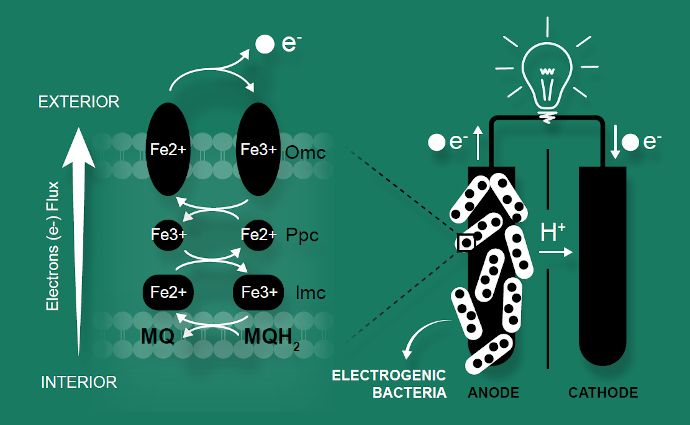
The electrogenic bacterium Geobacter sulfurreducens transfers electrons to the cell’s exterior and produces electricity in microbial fuel cells. The outer membrane cytochrome c OmcF is involved in this respiratory pathway. The molecular bases for the modulation of OmcF’s redox behaviour were determined. Measurements of electron production and electron flux rates revealed
that the bacterial electron flow is regulated by increasing the reduced/oxidized ratios of the cytochromes in response to a decrease of the oxidative activity of the extracellular metals. The electron flow is independent of the concentration and type of oxidant and results in ATP homeostasis.
 

highlight 2020


Representative Projects

  • “Look out over the wall: rational powering of microbial nanowires for sustainable bioenergy-based applications”, FCT-MCTES, Total and Unit funding: €220,459, Carlos Salgueiro (PI).
  • “The way forward: optimization of respiratory electron transfer chains toward sustainable microbial electricity production”, FCT-MCTES, Total and Unit funding: €166,862, Carlos Salgueiro (PI).
  • “The difference a cell wall makes: optimization of bioelectrochemical systems by exploring the paradigm of extracellular electron transfer in Gram positive bacteria”, FCT-MCTES, Total funding: €196,926, Unit funding: €24,000, Carlos Salgueiro (Collaborator).

Selected Publications

Ferreira, MR; Fernandes, TM; Salgueiro, CA. 2020. Thermodynamic properties of triheme cytochrome PpcF from Geobacter metallireducens reveal unprecedented functional mechanism. BIOCHIMICA ET BIOPHYSICA ACTA-BIOENERGETICS, 1861, DOI: 10.1016/j.bbabio.2020.148271
Chabert, V; Babel, L; Fueg, MP; Karamash, M; Madivoli, ES; Herault, N; Dantas, JM; Salgueiro, CA; Giese, B; Fromm, KM. 2020. Kinetics and Mechanism of Mineral Respiration: How Iron Hemes Synchronize Electron Transfer Rates. ANGEWANDTE CHEMIE-INTERNATIONAL EDITION, DOI: 10.1002/anie.201914873
Fernandes, TM; Morgado, L; Salgueiro, CA; Turner, DL. 2019. Determination of the magnetic properties and orientation of the heme axial ligands of PpcA from Geobacter metallireducens by paramagnetic NMR. JOURNAL OF INORGANIC BIOCHEMISTRY, 198, DOI: 10.1016/j.jinorgbio.2019.110718
Teixeira, LR; Portela, PC; Morgado, L; Pantoja-Uceda, D; Bruix, M; Salgueiro, CA. 2019. Backbone assignment of cytochrome PccH, a crucial protein for microbial electrosynthesis in Geobacter sulfurreducens. Biomolecular NMR Assignments, 13, DOI: 10.1007/s12104-019-09899-6
Fernandes, TM; Portela, PC; Dantas, JM; Salgueiro, CA. 2018. Microbial electricity production: Biomolecular elucidation of extracellular electron transfer mechanisms of Geobacter metallireducens. FREE RADICAL BIOLOGY AND MEDICINE, 120, DOI: 10.1016/j.freeradbiomed.2018.04.287